Spokane Police Abuses: Past to Present

The People of Spokane vs. Law Enforcement Abuse, Impunity, Corruption, and Cover-up

Lies encouraged in police Special Investigations Unit — 60 Minutes, June 1, 2008

Posted by Arroyoribera on May 31, 2008

Chicago Cop: Lies Were Encouraged

May 30, 2008

(CBS) Indicted Chicago police officer Keith Herrera says his superiors knew and encouraged him to lie on reports so questionable arrests would stand up in court.

In his first interview, Herrera, who also admits to stealing money, takes Katie Couric inside the Special Operations Section, an elite group of officers, some of whom he says profited during their quest to take criminals off the streets in one of the city’s largest police scandals.

The report will be broadcast on 60 Minutes this Sunday, June 1, at 7 p.m. ET/PT.

Herrera and six fellow SOS members were charged with crimes including armed robbery and aggravated kidnapping - many against suspected drug dealers. They have all pled not guilty. They are also accused of routinely lying on police reports. “Creative writing was a certain term that bosses used to make sure that the job got done,” he says. His bosses, says Herrera, wanted the cases to stick in court. “I didn’t just pick up a pen and just learn how to [lie on reports]. Bosses, guys that I work with who were older than I was…It’s taught to you,” he tells Couric.

The SOS mission was to get drugs and guns off the street, he says, “at any cost.”

Getting the job done often entailed breaking the rules, says Herrera. He describes to Couric a hypothetical scenario where to make a case stick against a gunman who tossed his weapon, a cop would lie in the police report and say that the gun never left the man’s hand. “Do you want that guy…that just shot somebody to not go to jail because he threw the gun? Or do you want him to go to jail because he never let the gun out of his hand?” asks Herrera. “I know what I’ve got to do.”

Pressed by Couric that his implication was that few or no officers went by the book, Herrera responds, “Maybe [some obey the rules]. This isn’t…Podunk, Iowa. This is the city of Chicago….You’ve got to do a job,” he says. And he says he was told he was doing a good job. “I got high-fives and honorable mentions and department commendations,” says Herrera.

Eventually, Herrera tells Couric, he went way over the line, sometimes taking money stolen from suspects. Herrera rationalized his first cut of illicit money. “I’m going to go tell a supervisor? No. And you just tell yourself it’s not going to happen again…No one is going to know,” he tells Couric. It did happen again and often, says Herrera. According to prosecutors, SOS members stole hundreds of thousands of dollars.

On these raids and in the unit’s street work there was a senior officer in SOS, Jerry Finnigan, who, though not a sergeant was effectively “in charge” says Herrera. Officer Finnigan was indicted with the rest and accused of being their ringleader. He was once an idol of Herrera’s. “To me he was like Superman,” he tells Couric. But, he says, Finnigan went too far. According to Herrera, Finnigan came to him last summer with a plan to deal with two former colleagues set to testify against them. “Jerry Finnigan decided that they didn’t need to be breathing anymore,” says Herrera.

This was a tipping point for Herrera and a moment to seize some kind of redemption. “I don’t have my star or my gun, but I’m still a cop. I’m going to stop you from doing this,” he says he thought at the time. He went to the FBI, who gave him a device to record Finnigan. On the recording, says Herrera, “he called [the alleged murder plot] a ‘paint job.’ He just said ’some really good painters [would do the killing]. We’d never have to paint again,’” Herrera says Finnigan told him. Herrera says Finnigan even spoke of killing two more former Chicago cops from SOS. Finnigan was charged by federal prosecutors with planning a murder for hire based on Herrera’s recordings - a charge Finnigan denies.

Chicago Police Superintendent Jody Weis, brought in to stabilize the department after the SOS scandal, says Herrera’s story of street misconduct rings true. “I think there probably was an atmosphere…. ‘Maybe we are breaking the laws, but look what we’ve accomplished.’ They lost their way and it saddens me,” he tells Couric. Of the charge that supervisors knew and encouraged the misconduct, “That is horrific in my eyes,” says Weis.

Chicago Mayor Richard Daley acknowledges the taint on his police department left by the SOS indictments, but says his officers primarily help the public. “It could be 10 or 15 or 20 [misconduct incidents] but every day we’re answering thousands of calls….You don’t allow a series of things to overcome the police mission of serving and protecting the people of the city of Chicago,” he tells Couric.

Produced by Tanya Simon, Andrew Metz and Michael Radutzky
© MMVIII, CBS Interactive Inc. All Rights Reserved.

Posted in Corruption, Ethics, Independent Oversight, Know Your Rights, Lies Damn Lies and ..., Testimonies, Unanswered Questions | No Comments »

Former Spokane Police Officer and Military SpecialOps veteran replaces non-Spanish speaking member of Governor’s Hispanic Commission

Posted by Arroyoribera on May 31, 2008

The Washington State Hispanic Commission has chosen to replace its non-Spanish-speaking northeastern Washington representative (covering Spokane and surrounding counties) with a veteran cop and military special ops “expert”. Bob Cepeda is a former Spokane Police Officer and comes to the Governor’s Hispanic Commission at a time when the Spokane Police Department is involved in extensive controversies including unresolved killings of disable individuals, illegal strip searches of minority individuals, spying and civil liberties abuses, and charges of corruption and abuse of authority, as well as the recent forced resignation of a Hispanic member of the Spokane Police Advisory Committee due to accusations of corruption against her. The presence of Cepeda on the Governor’s Commission should be cause for concern given his extensive connections within various police and military agencies, as well as for the intense focus of the commission on gangs, a topic championed by the commission’s former chairwoman, Yvonne Morton-Lopez. Now chairwoman of the Washington State Human Rights Commission, Morton-Lopez has continued to press the focus towards gangs, a topic which in a state where minorities are grossly under-represented in law enforcement is fraught with serious dangers for communities of color. Why did the Governor consider a career cop to be the appropriate representative on her committee in this moment? When will the Governor consider someone who is actually from the community to be a “commissioner”?

http://www.cha.wa.gov/english/yvonne.shtml

Bob Cepeda

Ex-Spokane Police Officer and Military Special Ops named to Washington State Hispanic Commission

Counties: Ferry, Lincoln, Pend Oreille, Spokane and Stevens

(Term Expires 8/01/08 - 1st Term)

Work: Gonzaga University

502 East Boone

Spokane, WA 99258

Telephone: 509-323-3998

Email: cepeda@gonzaga.edu

Commissioner Cepeda is a born and raised native of New York City (Harlem) who currently resides in Spokane with his family.

Mr. Cepeda has over twenty five years experience working in the criminal justice field and seventeen years in military special operations. He is a current consultant and trainer on gangs, terrorism, ethics, crime prevention, and use of force issues. He is a subject-matter expert with the Washington State Criminal Justice Training Commission.

Mr. Cepeda is on staff at Gonzaga University as Associate Director of Campus Public Safety & Security. Mr. Cepeda is a member of the BRIDGE staff. The BRIDGE program is a pre-orientation designed to assist students who are in the ethnic and cultural minority in making a smooth and successful transition to Gonzaga University and the local area.

Mr. Cepeda is honored that the Governor, Commission on Hispanic Affairs and Gonzaga University have given him the opportunity to work with and for the Hispanic/Latino community of Washington State. He counts this as a blessing.

________________________________________________________________________________________________

(translation to Spanish by David Brookbank)

Comisión Hispana del estado de Washington reemplace a Comisionada quien no habla español con ex-policía de Spokane

La Comisión Hispanas del estado de Washington ha nombrado a un policía y militar de carera como reemplazo de su comisionada — quien no habla español — en el noreste del estado de Washington y Spokane. Bob Cepeda, ex-policía de la ciudad de Spokane y ‘experto’ en operaciones militares especiales, llega a la comisión en un momento en que la policía de Spokane esta involucrada en extensas controversias, incluyendo homicidios no resueltos de individuos incapacitados, cateos ilegales de minorías, espionaje y violaciones de derechos civiles, y cargos de corrupción y abuso de autoridad, igual como el caso reciente de la renuncia obligatoria de un miembro hispano del Comité de Asesoría Policíaca por acusaciones de corrupción en su contra. La presencia de Cepeda en la comisión de la Gobernadora ha de ser causa de preocupación dado a sus extensos vínculos dentro de varias agencias policíacas y militares, igual como su enfoque intenso en Padilla’s, un tema promovido en gran parte por la ex-presidenta y representante del noreste en la Comision Hispana, Yvonne Morton-Lopez. Ahora como presidenta de la Comisión de Derecho Humanos del estado de Washington, Morton-Lopez ha seguido enfocándose en el tema de pandillas, un tema lleno de peligros serios para las comunidades minoritarias, especialmente en un estado en donde las minorías culturales y raciales son severamente sub-representadas en las agencias policíacas locales, estatales y federales. Por que nuestra Gobernadora consideró un policía de carera apropiada para esta región en este momento? Cuando va a considerar la Gobernadora una persona de veras de la comunidad apropiada para ser “comisionado” o “comisionada”?

Posted in Corruption, Espanol, Ethics, Gangs?, History of SPD Abuses, Know Your Rights, Photographic Evidence, Racism, Unanswered Questions | No Comments »

Northwest Gang Investigators in Spokane, May 19-22, 2008

Posted by Arroyoribera on April 30, 2008

So-called “gang experts” from the Northwest Gang Investigators Association will invade Spokane from May 19 to May 22, 2008, bringing their ever blessed light to shine upon the allegedly serious problem of gangs in Spokane.

It is especially disturbing to see this organization coming to Spokane at this time given the fact that Spokane Police Department is facing a severe crisis of corruption, misconduct, improperly and incompletely investigated police homicides against civilians, a practice of counter-suits against citizens who complain, and an ongoing history of racism in police hiring and policing of the community.

May god help us!

One might recall how in late September 2007 the collective anti-gang brain trust of Spokane — the Gang Enforcement Team (GET) — was involved in a widely publicized scandal as a result of their dissemination of patently false information about a “three-day gang enforcement focus”. The ATF and the GET widely touted their reported “success” in rounding up 70 plus gang members and associates as well as a large amount of weaponry. As it turns out there was only one gun and a handful of gang involved individuals charged with any crime. What was portrayed as a massive anti-gang bust was revealed to be a hoax involving publication of false data and a large scale effort to seed the media with false information. The GET is composed of the Spokane Police Department, Spokane County Sheriff’s Office, Washington State Patrol, ATF, FBI, and other unnamed government agencies.

Not surprisingly, the restricted-attendance event has been promoted by Yvonne Morton-Lopez, the non-Spanish-speaking chairwoman of Governor Chris Gregoire’s Commission on Hispanic Affairs (CHA). Organizations such as the CHA and the Spokane Human Rights Commission have been at the forefront of organizations promoting “forums” on gangs run by the Spokane Police Department, COPS, and the Gang Enforcement Team.

At recent GET forums in Spokane, presenters have taken already unsubstantiated numbers on gang membership in Spokane and inflated them by 25%, claiming for example that the supposed 900 gang members in Spokane is now 1200.

In an environment of police abuses — corruption, violence against members of minority groups, lack of civilian oversight — and in a community with a significant history of racism, organizations such as the Morton-Lopez’s Commission on Hispanic Affairs and Terry Goetz’s Spokane Human Rights Commission are acting extremely irresponsibly and jeopardizing their organizations’ credibility as defenders of the rights of Spokane’s small minority populations.

(Note: Morton-Lopez has recently been named the head of the Washington State Human Rights Commission. It will be interesting to see how she promotes law enforcement interests and their questionable practices from that position.)

Despite evidence which counters the claims of law enforcement and those such as Morton-Lopez about gangs in Spokane, the campaign goes on.  Crime is down in Spokane, according to the police and FBI, despite SPD Corporal Lee’s best efforts to spin the statistics.  And that is with 25 less officers than the comparison year of 2004. Yet, the GET and the COPS program continue to promote their Gang Seminars in the community despite the questionable information presented by GET team members.

http://www.nwgia.com/downloads/2008spring_nwgiaconference-reg.pdf

Posted in All-white SPD?, Gangs?, Independent Oversight, Law, Lies Damn Lies and ..., Spokane Police vs. Youth, Trained to Kill, Unanswered Questions, War Abroad & At Home | No Comments »

Two Separate Societies: One in Prison, One Not — (Op-ed: Washinton Post)

Posted by Arroyoribera on April 20, 2008

washingtonpost.com

Two Separate Societies: One in Prison, One Not

By Marie Gottschalk

Tuesday, April 15, 2008; Page A15

Forty years ago, the Kerner Commission concluded in its landmark study of the causes of racial disturbances in the United States in the 1960s: “Our nation is moving toward two societies, one black, one white — separate and unequal.” Today we are still moving toward two societies: one incarcerated and one not. The Pew Center on the States released a study in February showing that for the first time in this country’s history, more than one in every 100 adults is in jail or prison. According to the Justice Department, 7 million people — or one in every 32 adults — are either incarcerated, on parole or probation or under some other form of state or local supervision.

These figures understate the disproportionate impact that this bold and unprecedented social experiment has had on certain groups in U.S. society. Today one in nine young black men is behind bars. African Americans now comprise more than half of all prisoners, up from a third three decades ago.

Sen. James Webb (D-Va.) held a remarkable set of hearings last October on mass incarceration in the United States. In his opening statement, Webb noted that “the United States has embarked on one of the largest public policy experiments in our history, yet this experiment remains shockingly absent from public debate.”

The leading presidential candidates have not identified mass imprisonment as a central issue, even though it is arguably the country’s top civil rights concern. Many of today’s crime control policies fundamentally impede the economic, political and social advancement of the most disadvantaged blacks and members of other minority groups. Prison leaves them less likely to find gainful employment, vote, participate in other civic activities and maintain ties with their families and communities.

Congress recognized some of these barriers recently when, after years of delay, it approved and sent to the White House the Second Chance Act, which President Bush signed into law last week. This legislation seeks to ease the reentry of prisoners into society by providing modest increases in support for mentoring programs, drug treatment, job training and education.

Bruce Western of Harvard soberly concludes in his landmark book “Punishment and Inequality in America” that mass imprisonment has erased many of the “gains to African American citizenship hard won by the civil rights movement.” Sen. Barack Obama glancingly made some similar points in an address at Howard University last September. But he generally has not focused on the perils of mass incarceration. Neither has Sen. Hillary Clinton, though the $4 billion anti-crime package she unveiled last week did call for elimination of the federal mandatory five-year sentence for minor crack cocaine violations. As for Sen. John McCain, civil rights and criminal justice policy are not among the 15 issues the Republican nominee highlights on his Web site. But America’s space program did make the top 15.

At the hearings last fall, Webb underscored a basic truth sidelined in most discussions of crime and punishment: The explosion of the prison population wasn’t driven so much by an increase in crime as by the way we chose to respond to crime. Even former president Bill Clinton, whose administration was an accomplice in the largest prison buildup in U.S. history, conceded in a keynote address at a University of Pennsylvania symposium in February commemorating the Kerner anniversary: “Most of the people who went to prison should have been let out a long time ago.”

A change of heart by Bill Clinton and other public figures will not be enough to reverse the prison boom. In rare instances, public officials have been moved by strong personal beliefs to empty their prisons. During his brief tenure as Britain’s home secretary early in the 20th century, Winston Churchill expressed deep skepticism about what could be achieved through incarceration, and he began releasing prisoners. Political leadership has been critical for major reductions in incarceration in other countries. But in many cases, the public and experts on criminal justice had to push politicians to begin emptying their prisons and jails.

It is a national disgrace that the U.S. incarceration rate is five to 12 times that of other industrialized countries as well as being the highest in the world. As Churchill once said, “The mood and temper of the public in regard to the treatment of crime and criminals is one of the most unfailing tests of the civilization of any country.”

Marie Gottschalk, an associate political science professor at the University of Pennsylvania, is author of ” The Prison and the Gallows: The Politics of Mass Incarceration in America.”

Posted in War Abroad & At Home | No Comments »

North Central High counselor working hard on behalf of U.S. military recruiters

Posted by Arroyoribera on March 23, 2008

Jane Umphrey, a counselor at Spokane’s North Central High School, has been hard at work on behalf of U.S. military recruiters. Here (click here for PDF file) are some documents obtained through a Freedom of Information Request to Spokane School District 81 in September 2005 and January 2007.

The letter from Russell J. Vaucher from the U.S. Army Recruiting Battalion in Seattle dated 10/4/04 was sent to North Central High School and subsequently e-mailed by the District to all schools on 12/3/04. Vaucher included Section 9528 of HR 1 (”No Child Left Behind” Act) which request schools to “provide, on a request made by military recruiters or an institution of higher education, access to secondary school students’ names, addresses, and telephone numbers”. As you will note in Vaucher’s letter, he request specific formats for providing the information to Joseph/Jenkins@usarec.army.mil.

This request for names of Spokane District 81 student information was made in the midst of a period of massive violations of law and policy by U.S. military recruiters. By May 2005 the extent of the violations and abuses was international news and the military had shut down recruiting for a day to attempt to get a handle on the abuses.

Department of the Army Recruitment Letter to North Central High School 10-4-2004 and related documents

U.S. military recruiter misconduct is a very well established fact and has been criminally prosecuted on multiple occasions during this illegal invasion, occupation and brutalization of Iraq. The extent of the abuses was extensively documented in May 2007 (read 2007) by Nashville’s WTVF. The WTVF website includes, among many other print and video resources, a 30-minute documentary “Dishonorable Deceptions” on the recruitment of the mentally ill.

A couple years ago, U.S. military recruiters in Spokane attempted to recruit a legal Latin American immigrant out of a Spokane-area school. This kid has a 68 IQ, suffered a stroke at birth, and was in special education. His parents do not speak English. They had the nerve to visit the kid at school and at his home. After his parents complained to me, I contacted the recruiter and told him that he could certainly continue his efforts if he chose to but, if he did so, he would face being accused and hopefully charged. That was the last the family heard of him.

In addition, there is this e-mail by Frank Shaffery, the U.S. Army Recruiting Command’s deputy director of recruiting operations.
http://www.newschannel5.com/Global/story.asp?S=6488309&nav=menu374_2_2

“Established cases” is only a small reflection of the actually extent of the problem. Again, the U.S. Government Accounting Office (GAO) report in August 2006 which stated, “available service data show that between fiscal years 2004 and 2005, allegations and service-identified incidents of recruiter wrongdoing increased, collectively, from 4,400 cases to 6,600 cases; substantiated cases increased from just over 400 to almost 630 cases; and criminal violations more than doubled from just over 30 to almost 70 cases.”
http://www.gao.gov/highlights/d06846high.pdf

You will note the words “service-identified incidents” in the GAO report and you will note the number of substantiated cases increasing to a number almost double that which you present. Search the web and talk to real people in our community and you find many more allegations. No one has to doubt that the military and the Bush administration have little interest in substantiating and investigating the extent of the violations. Suffice it to say that it did not take more than a few weeks for the first major exposes on the issues before the US military took the unprecedented step of shutting down recruitment for a day to try to correct its rotten, criminal (again see the GAO stats) recruitment efforts.

Ignorant as they may be of the realities of the Middle East and of modern warfare, the U.S. president and his “chickenhawk” minions are sufficiently astute to understand that a draft would constitute the collapse of the entire house of cards and would have us once again have us remembering Kent State.
http://spokanepoliceabuses.wordpress.com/2007/08/06/know-your-rights-tin-soldiers-and-nixons-coming/

The U.S. military utilizes tens of thousands of mercenaries — US and foreign — in Iraq. The military is severely broken. They are desperate for cannon fodder and are engaged in an ongoing campaign of false advertising.

Be assured that additional recruitment scandals will be forthcoming, as the abuses are occurring even as we write.
The public will continue to respond to the abuses and will legitimately continue to focus on recruiters and their superiors, all of whom are paid by the taxpayer and are subject to law.

More important than the numbers of abuses by U.S. military recruiters is the type of abuses they have engaged in. We are talking not just about misleading and exaggeration. We are talking about rape, forgery, and other sorts of crimes. As this August 20, 2006, report discloses:

(quote) More than 100 young women who expressed interest in joining the military in the past year were preyed upon sexually by their recruiters. Women were raped on recruiting office couches, assaulted in government cars and groped en route to entrance exams. A six-month Associated Press investigation found that more than 80 military recruiters were disciplined last year for sexual misconduct with potential enlistees. The cases occurred across all branches of the military and in all regions of the country. (end quote)
http://www.cbsnews.com/stories/2006/08/19/national/main1913849.shtml

Even with the number of 630, this is not insignificant. A May 5, 2005, New York Times report found that 1 in 5 recruiters was under investigation.
http://rncwatch.typepad.com/counterrecruiter/2005/05/one_in_five_rec.html
If you do not want to get to the NY Times article via a counter-recruitment blog (though this one has great resources), go directly to the NY Times article.
http://www.nytimes.com/2005/05/03/national/03recruit.html?ex=1272772800&en=cb1c8ef720824a5d&ei=5088&partner=rssnyt&emc=rss
http://www.quakerhouse.org/Recruiter-Abuses-03.htm

Again, I believe it is important to frame this recruitment scandal in the context of a growing list of scandals related to the U.S. defeat and fiasco in Iraq — 1) the original lies and deceptions used to convince the world and justify the invasion; 2) the cover-ups related to U.S. war crimes; 3) the thefts and maladministration of billions by U.S. forces, contractors, and companies; 4) the lies to soldiers, families and countries about the circumstances of deaths, such as those of Pat Tillman in Afghanistan and the lies about the story of Jessica Lynch and the death of her fellow soldiers; and many, many other scandals, some yet to come to light.
http://www.salon.com/opinion/feature/2008/03/19/iraq_five/

Those who seek to defend this Bush/Neo-Con fiasco will always find themselves behind the fact that it is destined to be described as one of the biggest military fiasco in human history — and perhaps at the top of the list. The final consequences of the war are yet to be known. Will it lead to collapse of the U.S. economy? Will it lead to a nuclear confrontation in the Middle East? How many thousands and tens of thousands of U.S. troops will return home to kill themselves, live with mental illness, and destroy the lives of their families? How far will the image and power of the U.S. decline? Time will tell. In the meantime, facts point to a greatly diminished U.S. and a legacy equal to that of the U.S. defeat in Vietnam. How long will we be subject to the apologists?

Posted in Freedom to Fascism, Know Your Rights, Lies Damn Lies and ..., Surveillance Society, US Military abuses, Unanswered Questions, War Abroad & At Home | No Comments »

Police say they use taser on non-violent people

Posted by Arroyoribera on March 13, 2008

http://noworldsystem.com/2008/03/11/police-say-they-use-tasers-on-non-violent-people/

Police say they use Tasers on non-violent people
Internal documents show the weapon has been employed simply to get some suspects do what they are told

The Vancouver Sun
March 8, 2008

Vancouver police regularly use Tasers to subdue people who are unarmed and non-violent, according to internal reports released by the force.

On Friday, in response to a Freedom of Information request, VPD published on its website details of the about 150 times officers drew their Tasers from 2002 to early 2007.

The more than 70 pages of reports include cases where the electric shock weapon was drawn from its holster but not fired.

The reports cover cases in which the Taser was fired at a suspect from a distance and cases where it was used in “drive stun” mode — where a shock is administered by holding the device directly against a suspect.

The reports indicate that, in most cases in which Vancouver officers fired the Taser from a distance, the person was acting violently — from fighting with officers to threatening themselves or others with a weapon.

“[Officers] observed the male stabbing himself in the stomach with a pen,” reads one report from 2006. “When [officers] challenged the suspect, he ran at them and the [Taser] was fired. The suspect immediately fell to the ground and was handcuffed.”

However, in a number of cases, police used the Taser as soon as someone displayed a “fighting stance” or simply to get a non-violent suspect to do what they were told.

“Suspect fled from plainclothes members and resisted arrest when caught. Suspect was taken to the ground but refused to allow [officers] to handcuff him and held his arms underneath his body,” reads one report from 2006. “Strikes and open hand techniques were attempted but the suspect was still resisting. A [Taser] drive stun was applied to the suspect’s lower back and the suspect was then handcuffed.”

Jason Gratl, president of the B.C. Civil Liberties Association, said he was troubled to see Vancouver police are using the Taser as a compliance tool.

“The officers seem content to Taser individuals for lack of compliance with verbal commands or aggressive posturing,” said Gratl. “It is dead certain from these reports that Tasers are not merely an alternative to the use of sidearms but are used in practice as a convenient tool to gain physical control over individuals.”

There is debate over whether the Taser should be used to get non-violent suspects to comply with police orders.

In December, Paul Kennedy, head of the RCMP’s Commission for Public Complaints, published a report saying Tasers were used too often and recommended police use them only against suspects who are being “combative” or “posing a risk of death or grievous bodily harm” to themselves or others.

VPD Const. Jana McGuiness said the force believes the Taser is sometimes the safest option for controlling someone who is resisting arrest. “The problem is when you have a subject resisting to that degree, your chances of injuring yourself or that person escalates,” she said. “The Taser allows [police] to gain control with the minimum amount of injury to themselves or the suspect.”

According to the VPD, suicide attempts were an issue in about one in five Taser deployments and drugs or alcohol were a factor in one in three.

Ohio: Travellers Threatened With Arrest In Storm
http://abclocal.go.com/kabc/story?section=weather&id=6008531&pt=print
Japanese coastguard ’shot’ whaling activist
http://www.guardian.co.uk/environment..rc=rss&feed=networkfront

Chicago Links School Cameras to Police Squad Cars
http://www.chicagotribune.com..meras-07mar07,1,4279778,print.story

Britain Makes Camera That Sees Under Clothes
http://www.reuters.com/article/newsOne/idUSL0926757420080309

Britain Building Stealth DNA Database
http://www.dailymail.co.uk/pages/li..528857&in_page_id=1770

Posted in Independent Oversight, Prison Industrial Complex, Surveillance Society, Tasers, Unanswered Questions, War Abroad & At Home | No Comments »

URGENT CALL — Spokane Campaign Against Violence Motivated by Hate

Posted by Arroyoribera on March 11, 2008

A CAMPAIGN AGAINST VIOLENCE MOTIVATED BY HATE

Working together to address the increase in random acts of violence against homeless individuals in our community. We hope as a community we can put an end to this appalling and frightening trend.

Central United Methodist Church

518 W 3rd

Tuesday March 18, 2:00 pm

Please RSVP with

Holly Jean Chilinski

Shalom Ministries

Shalom30@qwestoffice.net

(509) 455-9019

*********************************

http://www.spokesmanreview.com/media/video/?ID=844 http://seattletimes.nwsource.com/html/localnews/2003089027_webhomeless27.html  http://thegimpparade.blogspot.com/search?q=spokane  http://thegimpparade.blogspot.com/2006/07/disabled-homeless-man-set-afire-after.html


Posted in Ethics, In Collective Self-Defense, Know Your Rights, Racism, Solutions, Testimonies, Urgent Call | No Comments »

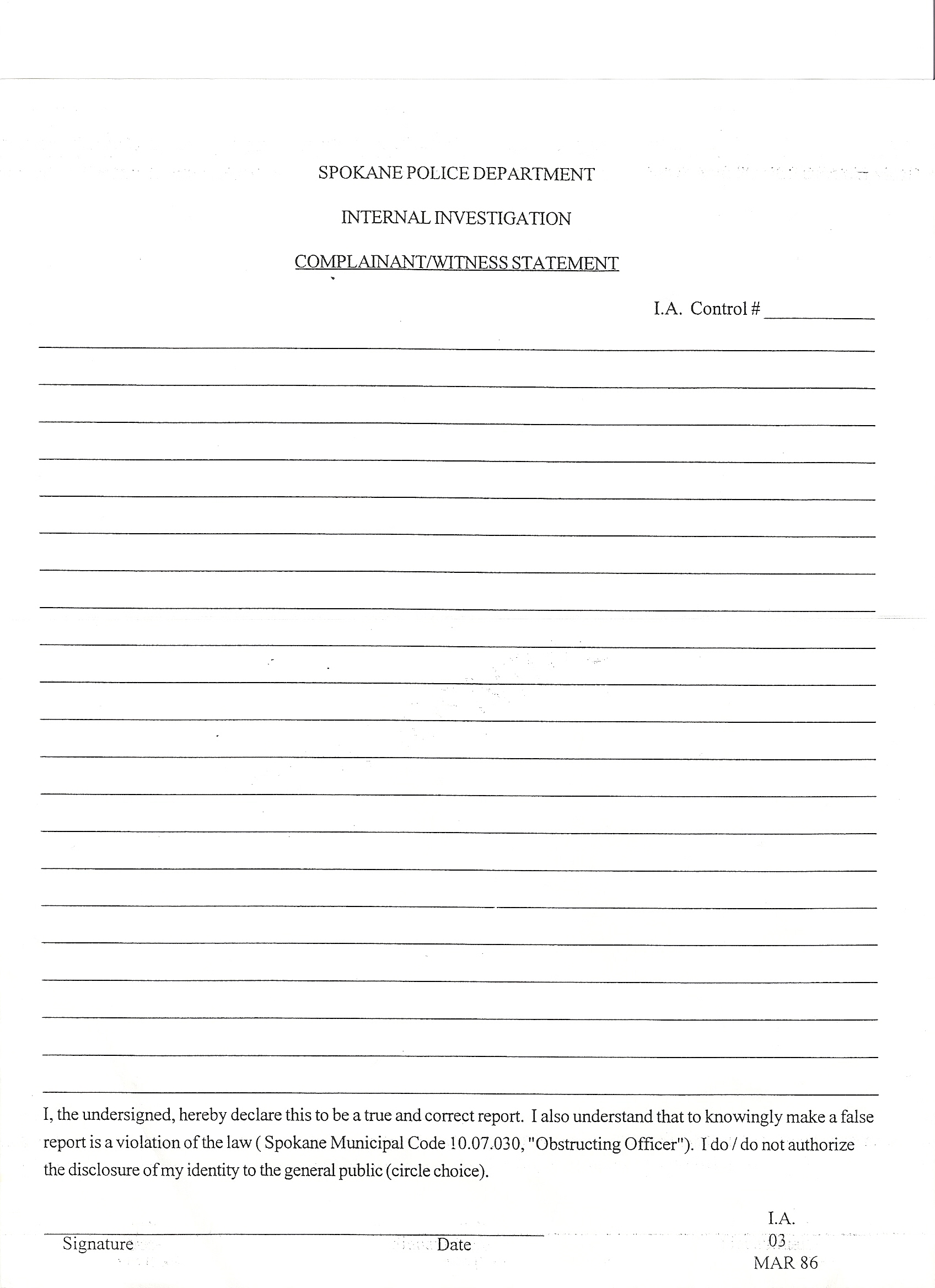
Spokane Police Complaint Forms

Posted by Arroyoribera on March 11, 2008

The first two are police internal affairs forms described by Spokane Police Internal Affairs Sgt. Jim Faddis as “unnecessary”.  They were obtained from by me from Sgt. Faddis and a colleague at the Police Internal Affairs Office located at the time in the Monroe Court Building in downtown Spokane.  Faddis had initially refused to provide the documents but when I told him that I would simply file a public disclosure request and then sue if they were not released, he hand them to me.

Spokane Police Internal Affairs Form 1

Spokane Police Internal Affairs Form 2

The second two are the front and back of a form that SPD reluctantly developed in a couple years ago after persistent demands from the community.

How to File a Complaint about Spokane Police Misconduct 1

How to File a Complaint about Spokane Police Misconduct 2

Posted in History of SPD Abuses | No Comments »

Deputy dumps quadriplegic from wheelchair in front of jail camera and colleagues

Posted by Arroyoribera on March 10, 2008

Law enforcement in the United States has become a threat to public security.

Take Spokane, Washington, where law enforcement beat, tasered, hog-tied and suffocated a disabled and innocent man, Otto Zehm, who later died. Spokane, Washington where suicidal Josh Levy was subject to 18 hours of police tactics prior to a botched tasering which prompted him to jump to his death from the Monroe Street Bridge.

Or take Hillsboro, Florida, where a Deputy — not believing that a man was a quadriplegic — violently and criminally dumps him out of his wheelchair as a way to prove it. And, of course, the surveillance video shows a Deputy laughing as he walks away from the crime.

http://www.heyokamagazine.com/HEYOKA.11.BrianSterner..htm

For more on abusive police officers, here are ten additional videos:

http://www.linkognito.com/b.php?b=727

Posted in Corruption, Ethics, History of SPD Abuses, Know Your Rights, No Sir Officer ____, Photographic Evidence, Spokane taser, Testimonies, Videos | No Comments »

FILM — Up The Ridge: A US Prison Story — Tuesday, March 11, 2008 Magic Lantern

Posted by Arroyoribera on March 9, 2008

Up The Ridge: A U.S Prison Story
A Shocking Look Inside The Incarceration Industry

Film Screening & Public Discussion

Tuesday, March 11, 2008 — 7:30 to 9:00 PM
Magic Lantern Theater, 25 W Main, Spokane

*Due to the graphic nature of this film, it is not recommended for children
Sponsored by November Coalition Foundation and Thousand Kites

For more information call (509)684-1550 or e-mail tom@november.org

Admission is free; donations gladly accepted!

Up the Ridge: A U.S. Prison Story

Up the Ridge: A U.S. Prison Story is a one-hour television documentary produced by Appalshop’s Nick Szuberla and Amelia Kirby. In 1999, Szuberla and Kirby were volunteer DJ’s for the Appalachian region’s only hip-hop radio program in Whitesburg, KY when they received hundreds of letters from inmates transferred into nearby Wallens Ridge State Prison, the newest prison built to prop up the region’s sagging coal economy. The letters described human rights violations and racial tension between staff and inmates. Filming began that year and, through the lens of Wallens Ridge, the film offers viewers an in-depth look at the United States prison industry and the social impact of moving hundreds of thousands of inner-city minority offenders to distant rural outposts. Up the Ridge explores competing political agendas that align government policy with human rights violations, and political expediencies that bring communities into racial and cultural conflict with tragic consequences. As the film makes plain, connections exist, in both practice and ideology, between human rights violations in Abu Ghraib and physical and sexual abuse recorded in American prisons.

Posted in Freedom to Fascism, Know Your Rights, Prison Industrial Complex, Prisons in Spokane, Racism, Solutions, Surveillance Society, Urgent Call, Videos | No Comments »

A 911 Nightmare — from the website of the Center for Justice

Posted by Arroyoribera on March 7, 2008

(From the website of the Spokane Center for Justice.)

A 911 Nightmare

Center files suit on behalf of Spokane man detained and endangered after he summoned police

There’s no question that Robert Chambers did the right thing after he and his ex-wife heard a gunshot in the parking lot of their north Spokane apartment complex. Investigating the sound of the gunshot, Chambers saw a man with a gun and called 911.

That he couldn’t have imagined is that he would be the one taken into custody and that after being handcuffed he’d be put in a patrol car that would then be used as a shield by Spokane police in a standoff with the gunman.

This alarming case of mistaken identity and endangerment is now the subject of a federal lawsuit. Chambers is a 57-year-old man who suffers from a debilitating bone disease. Lawyers for the Center for Justice are seeking damages for “unreasonable seizure” and for alleged post-traumatic emotional injuries triggered as a result of Chambers’s harrowing experience in February 2005.

In the complaint filed late last week against the City, former police chief Roger Bragdon, and two individual police officers, Chambers says he was told by the 911 operator to leave his apartment and go outside to meet responding officers. But when the officers arrived, the complaint alleges, it was Chambers who was ordered to behave like a suspect, lie on his stomach with two other innocent bystanders, and then handcuffed and placed in a patrol car. According to the complaint, Chambers was taken into custody despite the efforts of his ex-wife and daughter to inform the police that they were arresting the person who’d called for help. While in the car, Chambers says he even heard the police dispatcher informing the officers that the 911 operator was reporting that the officers had seized the wrong man. Still, it was only after another police officer arrived on the scene and intervened that Chambers was released.

“Why was I singled out to be cuffed and no one else?” Chambers asked in a complaint he wrote to Bragdon in a March 9, 2005 complaint about the incident. And why, he asked, wasn’t he moved out of harm’s way during the standoff with the shooter.

“The officers used the car I was in as a shield while the suspect was being told to come out of the apartment,” Chambers wrote. “Now had the suspect been a real nut case, I was a prime target and probably would have been shot.”

Chambers, who was an active volunteer in the city’s Community Oriented Policing Services (C.O.P.S.) program, wrote that he’d “never had anything but the utmost respect” for Spokane police until the incident. In the letter to Bragdon, however, he bitterly complained about being “publicly humiliated and totally disrespected by your officers” and reported that his frustration only mounted after he tried, several times, to file a complaint about the incident with the department’s internal affairs branch.

In a March 23, 2005 response to Chambers, Deputy Police Chief Jim Nicks, defended the officers actions of putting Chambers in handcuffs and “securing you in a patrol car.”

However,” Nicks conceded, “leaving you in a patrol car that possibly places you in harm’s way is not consistent with the mission of the police department. In reviewing this incident, it appears our officers made a tactical error.”

The lawsuit alleges that Chambers’s treatment violated his Fourth Amendment rights against unreasonable seizure; that the City is responsible for “failure to properly train” the officers involved, and that the City and former Chief Bragdon are responsible for the policies that led to the violation of Chambers’s constitutional rights.

Posted in History of SPD Abuses | No Comments »

Torok — a troubling choice as spokesperson on police interrogation of 12 year olds

Posted by Arroyoribera on March 6, 2008

The March 6, 2008 edition of the Spokesman-Review ran a story on the interrogation by Spokane Police and Spokane School District 81 Resource Officers of two 12-year-old girls, KellyAnn Cameron and Taylor Wyatt, who signed away their Miranda rights despite indications that they did not understand the process nor the implication of their actions. At least one of the girls was unclear as to whether or not an “attorney” and a “lawyer” were one and the same. Nevertheless, the four law enforcement personnel interrogated the girls without presence of parents or other staff.

The story is very troubling, both in the details of the incident itself as well as in the person chosen as the spokesperson for the Spokane Police Department, Sgt. Dan Torok.

Sgt. Dan Torok is perhaps the most controversial police officer in Spokane, both for his involvement in three high profile incidents in the last few years, two of which resulted in deaths, and for his belligerent online comments under the name “Dan” at blogs run by the local Spokesman-Review newspaper. In the matter of the Alford death by Torok’s service weapon, the chief of police ordered him to issue a Garrity letter, so infrequently used that Spokane County Sheriff’s investigators were confused about its propriety, according to the reporting of the Spokesman-Review. The Garrity letter effectively shielded Torok from questioning by investigators.

(It is highly ironic that Torok was shielded by the Chief from questioning from investigators over the Alford killing yet Torok is commenting publicly in defense of the SPD regarding the interrogation of the two twelve year old girls after questionable application of a Miranda waiving statement).

The killing of Alford by Torok remains controversial. Beyond that, however, the death of Otto Zehm is even more controversial not to mention the fact that the case remains unresolved from the perspective of many. To this date it remains unclear whether or not the FBI has a review of this matter open or not. And a report on the Spokane Police by consultant Mike Worley paid for by the city of Spokane remains incomplete to this date. The status of the contract the city signed with Worley’s company to write that report also remains unclear.

Torok was one of seven Spokane Police Officers involved in the brutal March 18, 2006 attack on and subsequent death of Otto Zehm, an unarmed mentally ill man who was beaten, tasered, hog-tied, kicked, kneed, and suffocated, before dying March 20, 2006 in what the coroner called a “homicide”.  Almost exactly a year later, Torok shot a homeless man, Jerome Alford, in a little trafficked area of Spokane.

As quoted in the Spokesman-Review article, Sgt. Torok waxes eloquent in justifying the actions of the SPD and suggests that police must interrogate pre-teens and other youth at school because the presence of parents is an impediment to their interrogation techniques.

I can assure you that Miranda rights are not in the curriculum of School District 81 in the seventh grade or elementary school and I believe it is safe to say that they are not in the curriculum through 10th grade as well. One of these girls was not even sure what the word “attorney” meant without asking for clarification.

Is Sgt. Torok — who with his men did not have the judgment to understand that Otto Zehm was “carrying” a pop bottle as opposed to being “armed” with a pop bottle before brutalizing him — a credible spokesperson for the tax-payer financed Spokane Police Department on issues of police discretion and police interpretation of policy? That the Spokane Police Department would even consider Torok in such a role shows just how far they are from understanding the crisis of credibility from which they are suffering.

Sgt. Torok — whose fellow SPD detectives did not have the training, judgment and ethical uprightness to understand that the photos taken by a Spokane Fireman of a minor girl with whom improper sexual contact occurred constituted evidence of a possible crime and therefore should have been confiscated as legal evidence rather than deleted at the direction of the detectives as in fact occurred — is going to be defending the SPD before the press and public in matters of alleged misconduct? Ironically, Torok’s experience at the center of significant controversy caused by his own poor judgment and questionable actions in the field makes his selection by the SPD brass as a spokesman to the media logical in a certain perverted bureaucratic sense. Furthermore, Torok has been practicing his role defending the SPD’s indefensible and ongoing scandals for months on the blogs of the Spokesman-Review, blogs such as Hard 7 and others. In his comments on those blogs he has become a master of stonewalling, rationalization, and the dodge.

Given his role in killing mentally ill Otto Zehm and his shooting to death of homeless Jerome Alford, it is extremely dangerous and troubling to see Torok resort on multiple occasions to calling members of the Spokane community participating in those blogs ‘mentally ill‘ when their comments simply seek to inform or when they express the disdain and disgust felt in many sectors of the community towards SPD misconduct, corruption, and lack of accountability.

In fact, prominent members of the city government and the professional community should be vocally outraged and up in arms that Torok is being allowed to play this role of public spokesman, given his direct role in the murder of Zehm and the killing of Jerome Alford, not to the mention the SPD’s severely botched “intervention” in the matter of Josh Levy who jumped to his death from the Monroe Street bridge following 18 hours of being surrounded and isolated by Spokane Police and after they lied to him and botched a sneak taser attack on him.

This is a police department with ZERO credibility in dealing with “other” (the term used by Dr. John “Gus” Olson, Spokane community activist and advocate for the disadvantaged, to describe those in Spokane who are rejected for being different, looked upon with disdain for being poor, excluded for being “other”, left to rot by a society incapable of real compassion). Recall Carmen Jacoby, who testified to the Chief of Police in the public forum at City Hall on September 19, 2007. Jacoby told of the Spokane policeman who told her that in relation to homeless people sleeping in the green space near a freeway on ramp, “I have a job to do…to get these shit bags out of this park” and then threatened to put her in the bag of his squad car if she persisted in demanding his name and badge number.

Having shown incompetence which endangers public safety and a shocking level of disdain for the poor, homeless, mentally ill, and non-white, does the Spokane Police Department now move on to 12-year-old girls? Apparently so.

The manner in which a police department deals with the most vulnerable among us is highly indicative of their attitude towards the people they pretend to “protect”. How the SPD handles pre-teen girls provides a window into the core attitudes of the Department. Many members of our community, like these girls, are easily exploited by a police department without adequate procedural training, supervision, and independent oversight.

The S-R article contains links to both the pertinent R.C.W. (Washington state Revised Code of Washington, i.e., the law in Washington state) and the OLR Research Report on the Miranda rights of children.

The study states: “In determining whether a juvenile effectively waived his Miranda rights, courts consider whether the juvenile had the capacity to understand the warnings given to him, the nature of his constitutional right to remain silent, and the consequences of waiving those rights.”

The parents of the two 12-year-old girls in this case have appropriately and effectively questioned whether in this case these young girls had in fact “the capacity to understand” the Miranda warnings given to them, their constitutional rights, and “the consequences of waiving those rights”, prior to the police interrogation.

This is an area of great controversy and a fundamental issue of individual rights and protections in our nation. While some states set higher ages for children to be able to waive their Miranda rights, other states require the presence of parents. Some states, including Washington, use a “totality of circumstances” test. It is heartening to see that the ACLU is involved.

I, for one, do not trust the judgment of SPD officers in the field nor their integrity in reporting the of facts. In the case of the interrogation of these two pre-teen girls by SPD officers, that lack of integrity rises to such a level that a court would have difficulty establishing that these very young, very vulnerable girls clearly understood the waiving of their right within the “totality” of circumstances. With two Spokane Police officers and two District 81 resource officers in the room, and with at least one of these girls not certain if an attorney and a lawyer are the same thing, clearly there was an intimidation/coercion factor.

I would certainly be interested in the outcome of the internal affairs complaint filed by these parents. Sgt. Jim Faddis used to be an internal affairs officer so he could help the Spokane people and media out on that one. Sgt. Faddis was asked by me on the S-R’s Hard 7 blog (where he blogs under the names “Jim F” and “Kevin”) to clarify the exact procedure for making an internal affairs complaint in Spokane. Not surprisingly, Faddis has failed to respond to that request.

It would also be nice to get more comment from Spokane School District 81 on the parents’ request for a change in the policy regarding police interrogation of children at school. I for one would strongly support changes in the policy as well as a public education effort to educate Spokane area youth on their rights in dealing with the police.

Posted in Ethics, History of SPD Abuses, Independent Oversight, Know Your Rights, Solutions, Spokane LE Personalities, Spokane Police Guild, Spokane taser, Testimonies, Torok, Trained to Kill, Unanswered Questions | 1 Comment »

Police Officers And Alcohol

Posted by Arroyoribera on March 4, 2008

While the Spokane Police Guild continues its deliberation over how much civilian oversight and subordination to the will of the public its officers are willing to accept, it is a good moment to look at the issue of police officers and alcohol. It is an increasingly well known fact that police officers are greatly affected by the stress of their jobs and that one consequence is rates of domestic violence greater than found in the general public. At the same time, the role excessive alcohol consumption in the issue of domestic violence is inadequately examined. More important, however, are the broader implications for public safety resulting from alcohol abuse by law enforcement personnel.

As previously addressed in this blog, a stag party held at the Spokane Police Guild club a number of years ago resulted in a precedent setting Supreme Court case dealing with public access to information. The Supreme Court decision quoted the Spokane City Attorney stating via affidavit that: “Release of this information, under the circumstances presented by this case, will cause substantial and irreparable damage to the Spokane Police Department’s ability to operate as a law enforcement agency, which is a vital governmental function.

And the “irreparable damage” to the Spokane Police Department has continued to this day.

Of course, the problem of alcohol abuse by law enforcement is not limited to just Spokane Police officers, of course. The Seattle P-I’s August 2007 special series documents in detail the preferential treatment of police officers throughout Washington state when they are stopped for driving under the influence of alcohol.

The article refers to two Spokane County Sheriff’s officers “who were caught driving drunk, a sergeant who tipped his truck over was given a reprimand and a deputy who was simply pulled over on a freeway got an eight-day suspension.”

More recently the people of Spokane have been subject to two grave alcohol related incidents.

In the first, a controversial Spokane police officer — already under scrutiny for his ownership of a drug house less than two blocks from an elementary school — left a Spokane bar under the influence of alcohol and shot a man in the back of the head, endangering the residents of the Peaceful Valley neighborhood of Spokane. The officer, Jay Olsen, faces charges while the man he shot and accused of stealing his truck has been acquitted of the charges against him. To make matters clearer, the city of Spokane has walked away from Olsen and left him to defen